
Luxury Botswana Wildlife Safaris
The Ultimate Guide to Africa’s Most Exclusive Wilderness
If there is a single destination in Africa that the luxury safari world regards as its gold standard, it is Botswana. This landlocked country in southern Africa has made a strategic decision that sets it apart from every other wildlife destination on the continent: it has chosen to pursue high-value, low-volume tourism as a matter of national policy, deliberately limiting the number of visitors to its wilderness areas while investing in the conservation infrastructure that keeps those wilderness areas extraordinary. The result is a safari experience of unmatched exclusivity — vast, pristine ecosystems shared with very few other travellers, wildlife encounters of extraordinary intimacy, and a collection of lodges and camps that represent the very pinnacle of what luxury in the African wild can achieve.
Botswana is not a destination for travellers seeking the familiar comforts of a conventional hotel or the reassurance of a well-trodden tourist trail. Its greatest wild places — the Okavango Delta, the Linyanti and Selinda concessions, the Central Kalahari, Chobe National Park — are remote, genuinely untamed, and deliberately kept that way. What luxury means here is not marble lobbies or infinity pools overlooking a manicured garden; it is a private mokoro gliding through papyrus channels at dawn, a private aircraft banking over the Delta’s endless network of waterways, and a guide of exceptional skill who has spent decades reading a landscape that most people will never see. In Botswana, luxury and wilderness are not in tension. They are, in the hands of the country’s finest operators, the same thing.
Why Botswana Sets the Global Standard for Luxury Safari
Botswana’s approach to wildlife tourism is rooted in a philosophy adopted by the government in the 1990s: that the country’s wild places are too valuable — ecologically, economically, and culturally — to be compromised by mass tourism. Visitor numbers to national parks and game reserves are strictly controlled. Concession fees are among the highest in Africa, deliberately pricing out operators who cannot deliver an experience worthy of the wilderness they are managing. Daily conservation levies are charged to every visitor. And photographic safari is the only form of hunting permitted in the great majority of the country’s wildlife areas.
The consequences of this policy are visible everywhere. Botswana’s wildlife populations are healthy and growing. Elephant numbers — approximately 130,000, the largest population in Africa — are a source of national pride and occasional controversy, but their presence in extraordinary concentrations transforms game drives into encounters of a scale found nowhere else on earth. Lion, leopard, cheetah, wild dog, and spotted hyena populations are robust. The Delta’s waterways support hippo, crocodile, sitatunga, and red lechwe in numbers that have no parallel elsewhere in Africa.
The luxury camps that operate within this framework — on long-term concessions that they are contractually required to manage to conservation standards — are among the finest in the world. Small in size, exceptional in quality, and staffed by guides whose knowledge of their specific concession is intimate and encyclopaedic, they deliver an experience that justifies every dollar of Botswana’s premium price point.
Top Destinations for Luxury Wildlife Safaris in Botswana
The Okavango Delta
The Okavango Delta is one of the natural wonders of the world — a vast inland river delta in north-western Botswana where the Okavango River flows down from the Angolan highlands and fans out across the Kalahari basin, creating a mosaic of permanent waterways, seasonal floodplains, palm-studded islands, and open grasslands that covers approximately 15,000 square kilometres at peak flood. It is a UNESCO World Heritage Site, a Ramsar Wetland of International Importance, and — for the lucky few who experience it — a place of almost hallucinatory beauty.
The Delta’s wildlife is extraordinary in its variety. Elephant move between islands in their hundreds, swimming the deeper channels with only their trunks above water. Hippo patrol the papyrus-lined waterways with territorial conviction. Lion, leopard, and wild dog hunt across the floodplains. Sitatunga — a semi-aquatic antelope with splayed hooves adapted for walking in swamp — move through the reed beds with an elegance that seems improbable for an animal of their size. And the bird life — over 400 species recorded — includes the African fish eagle, the pel’s fishing owl, the malachite kingfisher, and the saddle-billed stork in numbers and proximity that reduce serious birders to barely coherent enthusiasm.
The Delta’s seasonal flooding — peaking typically between June and August as the Angolan rains travel slowly southward — transforms the landscape and concentrates wildlife on the permanent islands in extraordinary numbers. Game drives give way to mokoro excursions (the traditional dugout canoe, poled by expert guides through shallow channels between reed beds and water lilies), motorboat safaris across open lagoons, and guided walks on the islands — where encountering elephant or lion on foot, accompanied by a skilled guide, is part of the Delta experience rather than an exceptional rarity.
Luxury camps in the Okavango are accessed exclusively by light aircraft — there are no roads — and this isolation is fundamental to their character. The finest properties offer just six to eight tents, positioned on islands or water’s edge with views across the floodplain that change hour by hour as light moves across the water and wildlife gathers and disperses. Service is exceptional; guiding is among the best in Africa; and the sense of being genuinely in the wild, genuinely far from anywhere, is absolute.
The private concessions surrounding the Delta — Mombo, Vumbura, Jao, Abu, Duba, and others — offer exclusive wildlife areas managed by a single operator, with no other camps or vehicles sharing the concession. Game drives in a private concession mean that when you find a wild dog den, a lion kill, or a leopard with cubs, you are the only vehicle present. That experience — wildlife observed without competition, without noise, without the social pressure of other tourists — is what Botswana’s premium price point buys, and there is nothing quite like it anywhere in Africa.
Chobe National Park
Chobe National Park, in northern Botswana along the Chobe River that forms the border with Namibia, is home to Africa’s largest elephant population — herds of several hundred animals converging on the river at dusk create one of the continent’s most staggering wildlife spectacles. The Chobe riverfront is also outstanding for lion, leopard, wild dog, buffalo in enormous herds, sable antelope, roan antelope, and a bird list that includes the African skimmer, rock pratincole, and a dazzling array of kingfisher species.
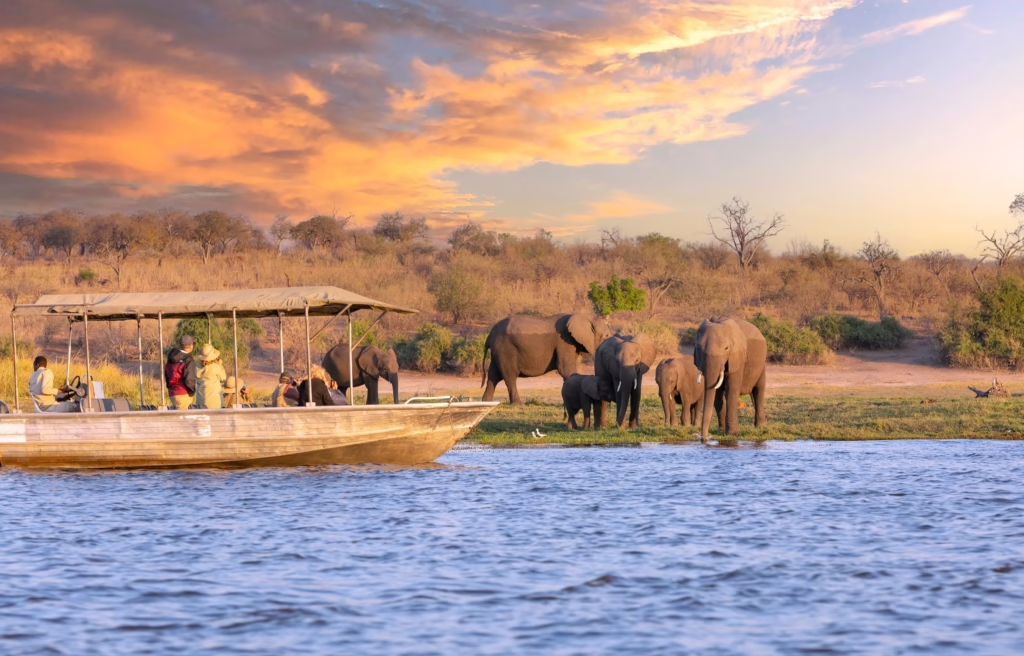
The signature Chobe experience is the river safari — a private boat cruising the Chobe River at dawn or dusk, surrounded by elephant families drinking and swimming at the water’s edge, hippo surfacing and sounding around you, and the extraordinary light of the Botswana dry season turning the water gold. It is a wildlife experience that no game drive can replicate, and at a top-tier luxury lodge on the river, the combination of boat safari, game drive in the park’s interior, and guided walks in private areas produces a game-viewing programme of exceptional depth and variety.
Luxury lodges on the Chobe River front are architecturally bold — open-sided pavilions cantilevered over the water, private decks where elephant pass within metres, and infinity pools whose surface merges optically with the river beyond. The proximity to Kasane airport, with connections to Maun and Johannesburg, also makes Chobe a natural anchor for a broader Botswana circuit.
The Linyanti and Selinda Concessions
The Linyanti and Selinda areas, in the far north of Botswana where the country meets Namibia’s Caprivi Strip and Zimbabwe, form one of Africa’s most exclusive and extraordinary wildlife destinations. These vast private concessions — managed by a small number of top-tier operators with long-term leases from the Botswana government — encompass floodplain, mopane woodland, and riverine forest that supports some of the finest predator concentrations in Africa.
Linyanti is famous for its wild dog population — the endangered African wild dog, found in significant numbers here, whose cooperative hunting and complex social dynamics provide some of the most exciting wildlife watching available. Lion prides are large and frequently encountered; leopard, cheetah, and spotted hyena are all present; and the elephant herds moving through the mopane woodland are among the largest and most dramatic in Botswana.
The Selinda Spillway — a water channel that periodically connects the Linyanti system to the Okavango Delta — is the setting for one of Africa’s most remarkable canoe safari experiences: a multi-day guided canoe journey through pristine wilderness, sleeping under canvas at fly-camps established by the guiding team ahead of the group’s arrival. This experience — properly demanding, genuinely wild, and utterly memorable — represents the apex of adventure within the luxury safari spectrum.
The Central Kalahari Game Reserve
The Central Kalahari Game Reserve is one of the largest protected areas in the world — 52,000 square kilometres of fossil river valleys, ancient sand dunes, and open grasslands in the heart of Botswana. It is vast, remote, extraordinarily beautiful, and very rarely visited — which is precisely its appeal for the traveller who finds the relatively accessible Delta and Chobe circuits too familiar.
Wildlife in the Kalahari is seasonal and requires patience and knowledge to find, but the rewards are exceptional. The famous black-maned Kalahari lions — larger and darker-maned than their savannah counterparts — are among the most magnificent of their species. Cheetah are present in good numbers. The annual wildebeest and zebra migration through the Kalahari — smaller in scale than the Serengeti’s spectacle but no less dramatic in the quality of predator interaction it generates — provides extraordinary game viewing between December and April.
Luxury camps in the Central Kalahari are minimal in number and exceptional in quality — small, beautifully designed, solar-powered properties that sit lightly on a landscape of extraordinary fragility and take their environmental responsibilities seriously. Game drives are conducted with a freedom and range unavailable in more densely settled wilderness areas, and the guiding — tracking lion through fossil river beds, reading the subtle signs of cheetah activity in the red sand — is at the very highest level.
Makgadikgadi Pans National Park
The Makgadikgadi Pans — ancient lake beds that dried up over thousands of years to leave a vast, glittering expanse of salt flats — are one of Botswana’s most surreal and otherworldly landscapes. At their edges, baobab-studded grasslands support lion, cheetah, brown hyena, oryx, and springbok. And between November and April, the Makgadikgadi hosts one of Africa’s most remarkable and least-known wildlife events: a zebra and wildebeest migration of over 25,000 animals — the second largest mammal migration in Africa after the Serengeti — that follows the seasonal rains across the pans.
Luxury camps here offer a combination of game drives, guided walks across the salt pans (an experience of extraordinary sensory strangeness — the silence and flatness of the pan stretching to a horizon that seems impossibly far away), and habituated meerkat encounters that are among the most joyful wildlife experiences available anywhere in Africa. The pans are also one of the world’s great locations for stargazing — flat, dark, and free of any light pollution, the night sky above the Makgadikgadi is among the most extraordinary spectacles that southern Africa offers.
What to Expect at a Luxury Botswana Safari Camp
Accommodation
Botswana’s top safari camps have set a global benchmark for luxury in genuinely remote wilderness. Tented suites — the preferred format at the very best camps, acknowledging the wild environment while delivering exceptional comfort — are typically large, impeccably furnished, and designed to blur the boundary between interior and landscape. Private plunge pools, outdoor showers open to the sky, handcrafted furniture, and curated art collections are standard. Several of the country’s most celebrated properties — Mombo, Jao, DumaTau, Zarafa — are routinely cited in global rankings of the world’s finest hotels, regardless of category.
What distinguishes Botswana’s luxury camps from equivalent properties elsewhere is the sense of genuine immersion. These are not hotels that happen to be located near a game reserve; they are wildlife camps that happen to offer exceptional comfort. The wilderness is not a backdrop — it is the point, and every aspect of the physical design acknowledges and celebrates it.
Guiding
Botswana’s professional guiding standards are among the highest in Africa, shaped by decades of investment in training by the country’s top operators and reinforced by the Department of Wildlife and National Parks’ licensing requirements. The finest Botswana guides are trackers, naturalists, ecologists, and storytellers simultaneously — able to read the spoor of a leopard in soft sand, identify a bird by a single note of its call, and explain the ecological significance of a termite mound with the same fluency and passion.
The concession model means that Botswana guides typically work the same area for years, building an intimate knowledge of individual animals and landscape dynamics that cannot be replicated by the rotating guide systems of busier destinations. When your guide knows that a specific leopardess has used a particular koppie as a resting site for the past three years, and takes you there at dawn and is right, the quality of that knowledge becomes viscerally apparent.
Activities
Game drives in open 4×4 vehicles — typically with a maximum of six guests and a guide and tracker — form the core activity at most Botswana camps. In private concessions, off-road driving is unrestricted, night drives are standard, and the pace and direction of each drive responds entirely to what the bush is offering rather than a fixed itinerary.
Water-based activities in the Okavango — mokoro excursions, motorboat safaris, fishing — add a dimension unavailable in purely terrestrial safari destinations. Guided walks, conducted by armed and qualified guides, are offered at most camps and represent the most intense and personal form of wildlife engagement available.
At the apex of the activity spectrum, multi-day fly-camping and canoe expeditions — setting out from a base camp with a small team, sleeping under the stars at temporary bush camps — represent the Botswana wilderness experience at its most immersive and most memorable.
Best Time to Visit Botswana for a Luxury Wildlife Safari
Botswana’s safari season reflects the rhythms of its rainfall and flooding cycle.
May to October (dry season) is the classic safari season. As water sources diminish across the landscape, wildlife concentrates around permanent rivers, channels, and waterholes, making game viewing progressively more productive as the season advances. The Delta’s annual flood peaks between June and August, creating the most dramatic waterscape of the year. Days are warm and sunny; nights are cold from June through August, requiring warm layers for early morning and evening game drives.
November to April (green season) brings rains that transform the Kalahari and Makgadikgadi into lush, productive grasslands, triggering the zebra migrations and producing the finest birdwatching of the year as migrants arrive from Europe and northern Africa. Predator activity remains excellent, the landscape is strikingly beautiful, and rates at many camps drop by twenty to forty percent relative to peak season.
The Okavango Delta is superb year-round, with the character of the experience shifting between dry-season land-based game drives and green-season mokoro and boat activity as the water levels dictate.
Planning Your Luxury Botswana Wildlife Safari
International travellers typically enter Botswana through Maun — the gateway to the Okavango Delta, connected by scheduled flights from Johannesburg (one hour fifty minutes) and Nairobi — or through Kasane for Chobe, connected from Victoria Falls and Johannesburg. From these hubs, a network of private charter aircraft connects Botswana’s wilderness areas efficiently, with flight times between destinations typically ranging from twenty minutes to one hour.
A well-designed Botswana luxury safari itinerary runs between eight and fourteen nights. The most satisfying circuits combine two or three ecosystems — a classic Delta and Linyanti combination, for example, or Okavango, Chobe, and Central Kalahari — to capture the full diversity of Botswana’s wilderness offering.
Botswana sits at the apex of the African luxury safari price spectrum. Fully inclusive rates at top camps range from approximately USD 1,200 to USD 4,000 per person per night, encompassing accommodation, all meals, twice-daily game activities with a private guide, laundry, and most park and conservation fees. Private charter flights between camps are additional and represent a significant component of the total budget for multi-destination itineraries.
Botswana pairs naturally with Zimbabwe (Victoria Falls and Hwange National Park), Zambia (South Luangwa), and South Africa (Greater Kruger) for broader southern Africa luxury circuits.
Responsible Luxury: Botswana’s Conservation Model
Botswana’s high-value, low-volume tourism philosophy is not merely a marketing position — it is a functioning conservation model that has produced measurable results over three decades. Wildlife populations have recovered and grown. Community conservancies adjacent to national parks provide local communities with income, employment, and genuine economic alternatives to poaching and land conversion. And the concession system ensures that the operators best placed to care for the wilderness are those with the longest-term financial interest in keeping it intact.
The finest Botswana camps contribute directly to conservation research — funding elephant movement studies, wild dog monitoring, lion population surveys, and vegetation mapping that informs the management of the entire ecosystem. Several operate formal anti-poaching units in their concessions, employing local trackers and rangers whose knowledge of the landscape makes them extraordinarily effective. Community development programmes — schools, clinics, bursaries, and enterprise development — are a standard commitment among the country’s leading operators.
When you invest in a luxury Botswana safari, you are not simply purchasing an extraordinary personal experience. You are participating in one of Africa’s most successful conservation experiments, and your contribution matters.
Final Thoughts
Botswana is the safari destination that safari professionals choose when they travel for themselves. That is not a coincidence. It is a place where the wilderness is genuinely intact, the wildlife is genuinely wild, the guiding is genuinely exceptional, and the experience of sitting in an open vehicle on the edge of the Okavango Delta as the sun drops below the tree line and a lion begins to call in the gathering dark is genuinely unlike anything else that travel — luxury or otherwise — can offer.
It is expensive, deliberately so. It is remote, deliberately so. And it is, for travellers who choose it, the finest wildlife safari destination in the world.
Come prepared to be astonished. The Botswana wilderness rarely disappoints.