
Masai Mara Kenya Luxury Safaris
The Ultimate Guide to Africa’s Greatest Wildlife Experience
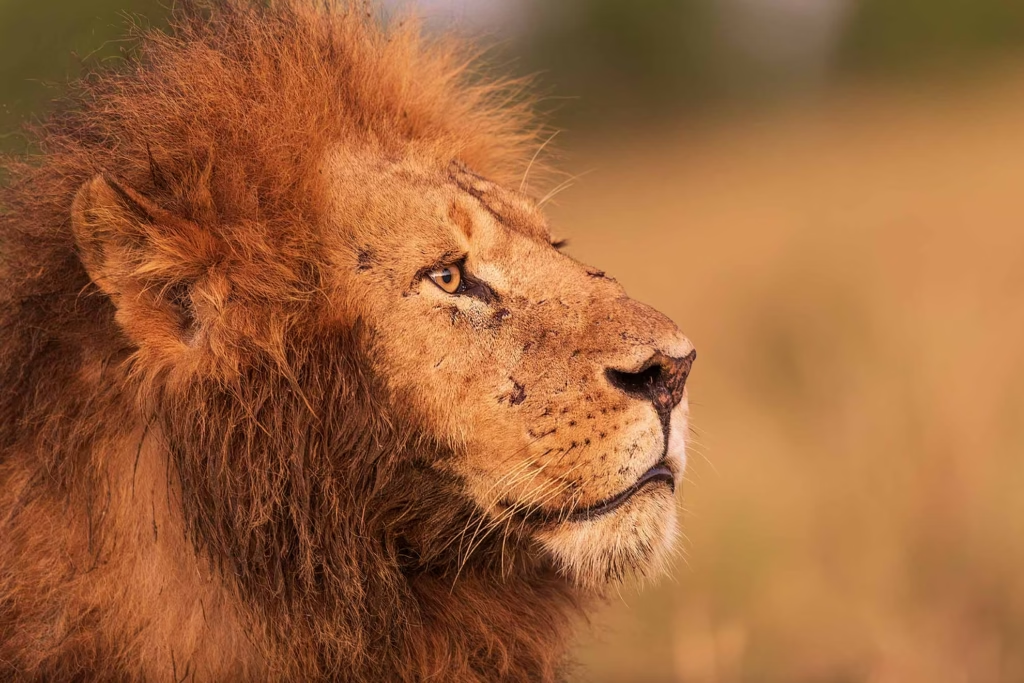
There are places in the world that exceed every expectation, and the Masai Mara is one of them. Stretching across 1,510 square kilometres of south-western Kenya, this iconic savannah ecosystem delivers the kind of wildlife encounters most people only ever see on a screen — lion prides sprawled in golden grass, elephant families moving in stately procession across the plains, and the thundering chaos of a million wildebeest crossing a crocodile-filled river. It is raw, ancient, and utterly magnificent.
What has changed in recent years is the quality of the experience surrounding that wilderness. Luxury safaris in the Masai Mara have reached a standard that rivals the finest hotels anywhere on earth — intimate tented camps with handcrafted furniture, gourmet meals served under a canopy of stars, private game drives guided by expert naturalists, and a level of personalised service that makes every stay feel singular. For the discerning traveller, the Masai Mara is no longer a compromise between comfort and adventure. It is both, in equal measure.
Why the Masai Mara is Africa’s Premier Luxury Safari Destination
The Masai Mara — or simply “the Mara,” as it is known locally — sits at the northern end of the greater Serengeti-Mara ecosystem, one of the most biodiverse landscapes on the planet. It shares an unfenced border with Tanzania’s Serengeti National Park, allowing wildlife to move freely across an ecosystem that has remained largely intact for millennia.
What sets the Mara apart from other African safari destinations is the sheer concentration of wildlife year-round. Even outside the famous Great Migration season, the reserve supports one of Africa’s densest lion populations, large herds of elephant, buffalo, and plains game, and a remarkable cast of predators including cheetah, leopard, spotted hyena, and African wild dog. Kenya’s Big Five — lion, leopard, elephant, buffalo, and rhino — are all present.
For the luxury traveller specifically, the Mara offers several distinct advantages. The Kenyan conservancy model — where private landowners partner with Maasai communities to create exclusive wildlife areas bordering the reserve — has produced some of Africa’s most extraordinary safari camps. These conservancies limit visitor numbers strictly, offer activities unavailable inside the main reserve (night drives, walking safaris, off-road driving), and generate direct income for Maasai communities who have chosen conservation over agriculture.
The Great Migration: Africa’s Greatest Wildlife Spectacle
No article on Masai Mara luxury safaris is complete without addressing the Great Migration — the annual movement of approximately 1.5 million wildebeest, 200,000 zebra, and 350,000 Thomson’s gazelle between the Serengeti in Tanzania and the Masai Mara in Kenya.
The Migration is not a single event but a continuous, year-round cycle. The most dramatic chapter unfolds between July and October, when vast columns of wildebeest push northward into Kenya, driven by the search for fresh grazing. The Mara River crossings — where thousands of animals plunge into crocodile-infested waters in scenes of extraordinary chaos and courage — are among the most visceral wildlife spectacles on earth.
Luxury camps position their guests to witness these crossings with intelligence and patience. A private vehicle, a knowledgeable guide, and the flexibility to wait at a crossing point for as long as it takes — without the pressure of a shared group itinerary — transforms a Migration safari from a lucky chance into a near-certainty. The finest camps also brief guests each morning on where the herds are moving, drawing on decades of guide experience and real-time communication with other vehicles and scouts.
Outside Migration season, the Mara remains exceptional. The short rains of November bring vibrant green landscapes and the calving season in the Serengeti. The dry months of January and February offer superb predator sightings as game concentrates around water. There is genuinely no bad time to visit.
Top Luxury Safari Camps in the Masai Mara
The quality and variety of luxury accommodation in and around the Masai Mara is unmatched in Africa. Here are the categories of experience on offer:
Private Conservancy Camps
The conservancies bordering the Mara — including the Olare Motorogi, Naboisho, Mara North, Lemek, and Ol Kinyei — are where the most exclusive safari experiences are found. Camps here are typically small (eight to twelve tents) and strictly limit vehicle numbers per sighting. Guests enjoy activities that the main reserve does not permit: guided walks with armed Maasai rangers, night drives by spotlights, sundowner stops in the open bush, and off-road driving to follow predators at close quarters.
These camps also play a direct conservation and community role. Revenue funds anti-poaching units, school fees for Maasai children, and wildlife monitoring programmes. Staying here means your travel budget actively supports the landscape you have come to experience.
Ultra-Luxury Tented Camps
At the pinnacle of the market, a handful of camps in the Mara have set a global benchmark for luxury in the wild. Expect tents of 80 square metres or more, furnished with antique-style pieces, Persian rugs, claw-foot baths, and private plunge pools overlooking the plains. Menus are created daily by resident chefs using fresh, locally sourced produce; wine cellars are curated; and butlers learn your preferences within hours of arrival.
These camps are designed to make solitude feel effortless. Meals are served wherever you wish — at a candlelit table in the bush, on your private deck, or beside a firepit under a sky undimmed by light pollution. Breakfast after a dawn game drive, with elephants moving in the middle distance, is the kind of memory that makes the journey worthwhile.
Mobile Migration Camps
For guests who want to follow the wildebeest herds as they move, mobile camps offer a remarkable solution. These semi-permanent camps are repositioned several times a year to place guests in the heart of the action — whether that means a riverside site for the Mara crossings in August, or the southern Mara grasslands where cheetah hunt in January. Despite the logistical complexity of moving an entire camp, standards are exceptionally high: proper beds, en-suite bathrooms with hot showers, and gourmet cooking follow you wherever the herds go.
What to Expect on a Masai Mara Luxury Safari
Game Drives
Game drives are the core of any Mara safari, and in a luxury setting they are structured around your interests and pace rather than a fixed group itinerary. Drives depart at first light — typically around 6.00 am — when predators are active and the quality of light for photography is extraordinary. An evening drive begins in the late afternoon, building to a sunset in the open savannah that defies description, before returning to camp after dark.
In private conservancies, drives can last as long as you wish. If a leopard is resting in an acacia tree, you stay. If a cheetah hunt is building, you wait. This freedom to follow the wildlife rather than the clock defines the luxury safari experience.
Walking Safaris
A guided walking safari in the Mara offers a perspective that no vehicle can replicate. Moving quietly on foot, accompanied by an armed Maasai guide and a senior naturalist, you become aware of the bush in an entirely different way — tracks in the dust, the alarm call of a francolin, the scent of an elephant herd. Distances are short and pace is gentle, but the intensity of the experience is profound.
Balloon Safaris
A hot air balloon flight at dawn over the Masai Mara is one of Africa’s most celebrated experiences. Drifting silently above the plains as the sun rises, watching herds of wildebeest and zebra move below, is a perspective that no other activity can offer. Most luxury camps arrange private or semi-private balloon flights, followed by a champagne breakfast served in the bush.
Cultural Experiences
The Maasai people have coexisted with the wildlife of the Mara for centuries, and the finest luxury camps offer authentic cultural engagement — visits to Maasai villages (manyattas), guided by community members who explain the significance of their traditions with pride rather than performance. Some camps employ Maasai rangers as lead guides, whose knowledge of the landscape and its wildlife is intimate and generational.
Best Time to Visit the Masai Mara
The Masai Mara can be visited year-round, but the experience varies meaningfully by season.
July to October is the most popular period, coinciding with the Great Migration river crossings. Camps fill quickly and rates peak; book twelve to eighteen months in advance for the best properties.
January to March offers exceptional predator sightings, warm weather, and lower rates. The landscape is drier and the grass shorter, making wildlife easier to spot.
November and December bring the short rains — brief afternoon showers that keep the air cool and the plains lush. Fewer visitors mean quieter game drives and often more flexibility at top camps.
April to June (the long rains) is the low season. Some camps offer reduced rates, the landscape is spectacularly green, and birdlife reaches its peak. Game viewing is still excellent, though tracks can occasionally become muddy.
Getting There: Planning Your Masai Mara Luxury Safari
Most international travellers arrive at Jomo Kenyatta International Airport in Nairobi, with excellent connections from Europe, the Middle East, and Asia. From Nairobi, a scheduled or charter flight to one of the Mara’s airstrips (Keekorok, Ol Kiombo, or Musiara) takes approximately 45 minutes and is the most efficient way to reach the reserve. Road transfers are available but take four to five hours and are typically reserved for those who want to explore the Rift Valley en route.
A typical Masai Mara luxury itinerary runs between four and seven nights. Many travellers combine the Mara with Amboseli National Park (for elephants against the backdrop of Kilimanjaro), the Laikipia Plateau (for rhino and wild dog), or a beach extension on the Kenyan coast at Lamu or Diani.
Costs for a fully inclusive luxury safari in the Masai Mara range from approximately USD 800 to USD 2,000 per person per night, covering accommodation, all meals, two daily game drives, a private naturalist, and most activities. Private conservancy fees and balloon flights are typically charged additionally.
Responsible Luxury in the Masai Mara
The Masai Mara faces real conservation pressures — encroachment, human-wildlife conflict, and the environmental impact of poorly managed tourism among them. The luxury conservancy model has proven one of the most effective responses: by attaching direct financial value to wildlife and wild land, it creates powerful economic incentives for Maasai communities to maintain open landscapes rather than convert them to agriculture.
When choosing a luxury safari operator, ask specifically about their conservation partnerships, community employment policies, and environmental practices. The most reputable camps are carbon-neutral or actively working toward it, use solar power, treat and recycle water, and publish transparent reports on their conservation and community contributions.
A luxury safari in the Masai Mara is one of the great travel experiences of the modern world — not because it insulates you from the wilderness, but because it allows you to engage with it more deeply, more knowledgeably, and more sustainably than any other approach. When a lion walks within metres of your vehicle at golden hour, or a river crossing erupts into noise and motion in front of your eyes, the quality of your tent or the excellence of your dinner becomes irrelevant. You are simply present, in one of the wildest places left on earth.